Singapore · History
From five pupils in a club hut to Southeast Asia's oldest British school
Tanglin Trust School turns 100 in 2025. Its century stretches from two borrowed huts at the Tanglin Club through wartime internment, three-school mergers, and a Portsdown Road campus that now serves 2,800 students.

Origins
Anne Griffith-Jones arrived in Singapore in 1923 to visit her brother. She had no formal teaching qualifications, but she had a clear purpose. In 1925 she opened a school in two huts on the grounds of the Tanglin Club, in the city's Claymore district, with five pupils. Her aim: give British expatriate children a decent education in Singapore so their parents did not have to ship them off to boarding schools in England. The school was known simply as Tanglin School.
It grew quickly. Assembly was held in the club ballroom. The Men's Bar was pressed into service as a classroom. By 1934, Griffith-Jones had opened a second site, a boarding school in the Cameron Highlands of Malaya, catering for pupils up to the age of 13 who had outgrown the Singapore school. Many children moved between the two, spending their early years in Singapore before heading to the cooler highlands.
The Japanese occupation ended both schools. The Cameron Highlands boarding school closed in 1941 after a polio outbreak and never reopened during the war. Tanglin School in Singapore shut in 1942. In 1943, Griffith-Jones herself was interned in Changi Prison. Both schools reopened in 1946 and 1947, and the Cameron Highlands site eventually closed for good as demand shifted back to Singapore. Griffith-Jones, known to her pupils as Miss Griff, was later appointed OBE for her work.
Into Trust hands
In 1958, Griffith-Jones retired and sold Tanglin School to the British European Association (BEA), the expatriate body that now operates as the British Association of Singapore. Three years later, in 1961, governance passed to a dedicated not-for-profit entity, Tanglin Trust Ltd, incorporated as a non-profit public company limited by guarantee. That structure, under which all fee income is reinvested in the school, remains in place today.
The trust expanded its footprint. In 1960, management of Raeburn Park School transferred to the BEA. That school had been opened in 1954 by the Singapore Harbour Board for the children of its expatriate staff. In 1971, the trust opened a third school, Weyhill Preparatory School. By the late 1970s, three separate institutions were operating under broadly the same umbrella and enrollment pressure was building.
The 1981 merger and the move to Portsdown Road
In 1976, Raeburn Park School moved to Portsdown Road, a quiet stretch winding through the Wessex Estate. In 1981, Tanglin Preparatory School and Weyhill Preparatory School followed, and all three merged at that single site to form Tanglin Infant School and Tanglin Junior School. The Portsdown Road campus has been the school's home ever since.
A nursery satellite, Winchester Nursery School, operated at Alexandra Park from 1976. It ran separately for twenty years before closing in 1996, when a purpose-built nursery unit opened on the Portsdown Road site. That same year, the late-1980s administrative centralisation under a single head was formalised in name: the institution became Tanglin Trust School.
Senior school and the dual sixth-form pathway
Until 2001, Tanglin stopped at age 13. That year it introduced a Senior School, taking students through to 18. A Sixth Form followed, initially offering A Levels only. In 2009 the school added the International Baccalaureate Diploma Programme alongside A Levels, creating what it describes as a dual pathway. The first IB cohort graduated in 2011. No other school in Singapore offers both qualifications at Sixth Form.
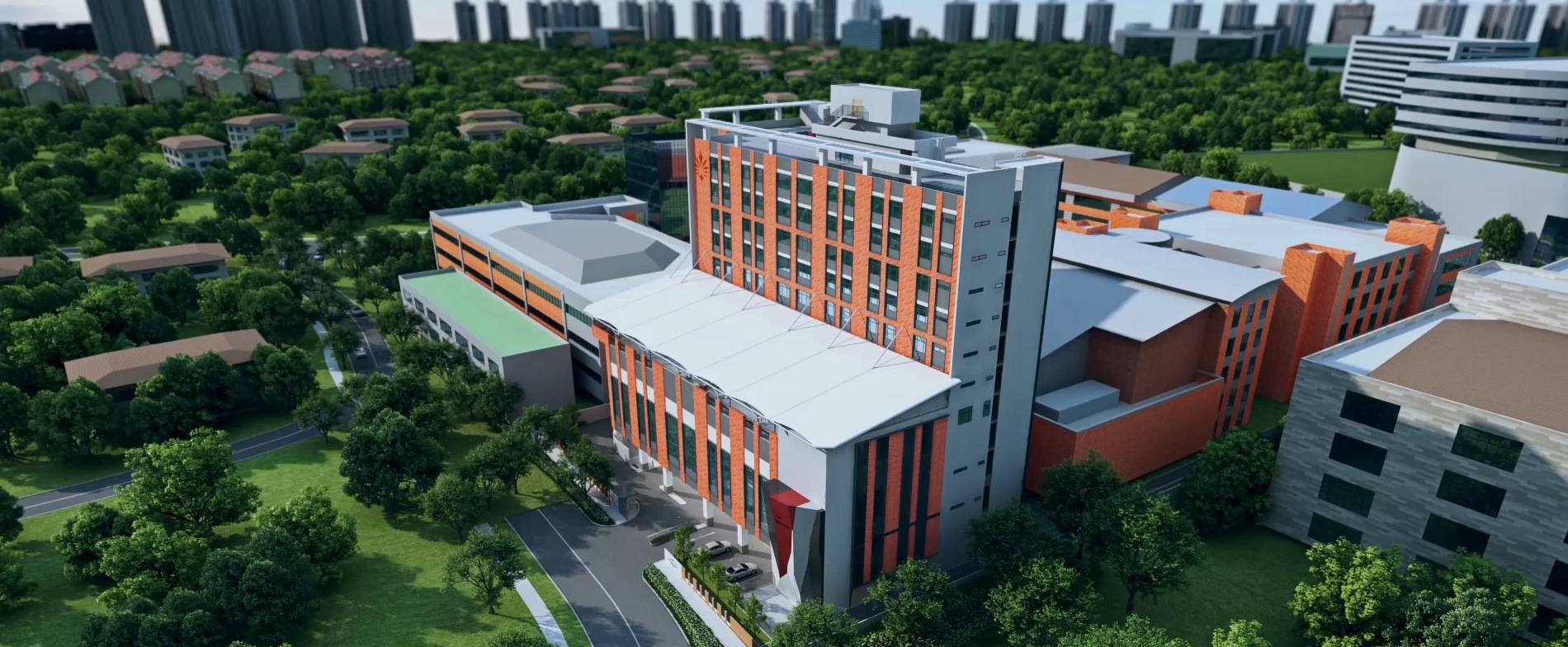
The lease on the Portsdown Road site was extended to 2038 in 2014, providing the security needed for further capital investment. In 2023 an 11-storey Centenary Building opened on campus, housing a 50-metre competition-standard swimming pool, an Olympic-standard gymnastics centre, an athletic development gym, a climbing wall, and a two-floor music department. The Junior School's Tower Block was redeveloped as a Junior Arts Centre, opening in the centenary year of 2025.
Curriculum and accreditation
The English National Curriculum underpins teaching from Nursery to Year 9. Above that, students sit IGCSE in Years 10 and 11, then choose between A Levels or the IB Diploma for the Sixth Form. The school has developed a bespoke 3-to-14 curriculum framework that adapts the British curriculum to an international context, incorporating cognitive science research and global perspectives. It also holds the Extended Project Qualification alongside A Levels.
Tanglin is the only school in Singapore subject to the British Schools Overseas (BSO) inspection framework, operated by Ofsted. In its 2025 inspection, all three schools, Infant, Junior, and Senior, were rated Outstanding in every category, including quality of education, personal development, behaviour, welfare and safety, and leadership. The school also holds EduTrust certification from Singapore's Committee for Private Education, Independent Association of Prep Schools (IAPS) membership, and COBIS affiliation.
Present day
Craig Considine, formerly headmaster of Millfield School in England, has been CEO since August 2018, taking over from Peter Derby-Crook, who held the post for over eight years. The school runs approximately 2,800 students across four sections, with around 750 in the Infant School, 750 in the Junior School, and 1,300 in the Senior School and Sixth Form. More than 50 nationalities are represented; roughly half hold British passports.
Results in 2025 placed 79 percent of IGCSE grades at A* or A, against 49.2 percent at independent schools in England, and 63 percent of A-Level grades at A* or A, against a national average of 28.2 percent in England. The IB Diploma average score in 2025 was 39 points with a 100 percent pass rate. Around 96 percent of graduates receive offers from their first or second-choice university. The Spear's Schools Index named Tanglin among the top 100 private schools in the world for the fifth consecutive year in 2026.
A centenary letter arrived from Buckingham Palace in July 2024. That September the school launched a travelling exhibition, 100 Years of Tanglin, drawing alumni and former staff from across decades. The centenary year closed with a Gala at Clifford Pier, a premiere concert at the Esplanade, and the publication of 100 Tanglin Tales. In April 2025, the school launched the Highlands Programme, a five-week residential for Year 9 students at a 15-acre campus in Gippsland, Australia, linking an outdoor education tradition back to the Cameron Highlands boarding school that Griffith-Jones opened ninety-one years earlier.