Singapore · History
From five pupils in a club hut to a century of British education
Tanglin Trust School opened in 1925 in two huts at the Tanglin Club. A hundred years on, it is Southeast Asia's oldest British international school, with 2,800 pupils and a campus built to last another century.

Anne Griffith-Jones arrived in Singapore in 1923 to visit her brother. She had no formal teaching qualifications, but she saw a gap. British expatriate families were shipping their young children back to boarding schools in England rather than keeping them in Singapore. In 1925 she opened a school in two huts on the grounds of the Tanglin Club, with five pupils. She called it Tanglin School.
The school outgrew the huts quickly. Assembly moved to the club ballroom, and the Men's Bar was pressed into service as a classroom. The mission was straightforward: keep British children in the region with their parents for as long as possible, while preparing them to slip back into schools in England without losing ground.
Expansion and Wartime Closure
In 1934, Griffith-Jones opened a second school, the Tanglin Boarding School in the Cameron Highlands in Malaya, for children who had outgrown the Singapore campus. Many pupils attended Singapore up to the age of eight before transferring to the highlands school, which catered for children up to thirteen. The Cameron Highlands campus closed temporarily in 1941 due to a polio outbreak, and in 1942 the Japanese occupation forced the closure of Tanglin School in Singapore entirely. Griffith-Jones was interned at Changi Prison in 1943. Both schools reopened in 1946 and 1947 after the war.
Change of Ownership and Institutional Growth
In 1958, Griffith-Jones retired and sold Tanglin School Ltd to the British European Association, the expatriate community body now known as the British Association of Singapore. Three years later, in 1961, governance passed to a new non-profit entity, Tanglin Trust Ltd, incorporated as a public company limited by guarantee. The school moved to Matheran Road in Tanglin Road around 1960 to 1961 and was renamed Tanglin Preparatory School to reflect its growing scope.
A separate school, Raeburn Park, had opened in 1954, founded by the Singapore Harbour Board for the children of its own expatriate staff. The Trust took over its management in 1974. Meanwhile, long waiting lists at the two existing schools prompted the Trust to open a third, Weyhill Preparatory School on Portsdown Road, in 1971. A nursery unit, Winchester School, opened at Alexandra Park in 1976.
The 1981 Merger and the Portsdown Road Campus
In 1981, Tanglin Preparatory, Raeburn Park, and Weyhill amalgamated into a single institution at Portsdown Road, operating initially as two largely separate schools: Tanglin Infant School and Tanglin Junior School. The campus that resulted from that merger is where the school sits today. In 1987, the two schools came together under one headteacher, Mrs Veronica Goodban. A Senior School followed, and a Sixth Form was introduced in 2001. In 1996, with a nursery unit now open on Portsdown Road and the former Winchester School closed, the institution adopted its current name: Tanglin Trust School.
Curriculum and Accreditation
The school follows the English National Curriculum from Nursery through to Sixth Form, supplemented by a bespoke framework it developed for pupils aged three to fourteen. Senior school students sit IGCSEs in Years 10 and 11. At Sixth Form, Tanglin is the only school in Singapore to offer a dual pathway, allowing students to choose between A Levels or the IB Diploma Programme; the IB was introduced in 2009, and the first cohort graduated in 2011.
Tanglin is the only school in Singapore inspected under the British Schools Overseas framework, recognised by Ofsted. All three schools, Infant, Junior, and Senior, have been rated Outstanding, the highest possible grade, at every inspection, most recently in 2025. The school also holds accreditation from the Council of International Schools, is a member of COBIS, IAPS, and FOBISIA, and carries Singapore's EduTrust certification. The Infant School is the first in Asia to achieve Curiosity Approach accreditation, and Tanglin was the first school outside the United Kingdom to be reaccredited Gold under the UNICEF Rights Respecting Schools Award, in 2023.
Campus Development
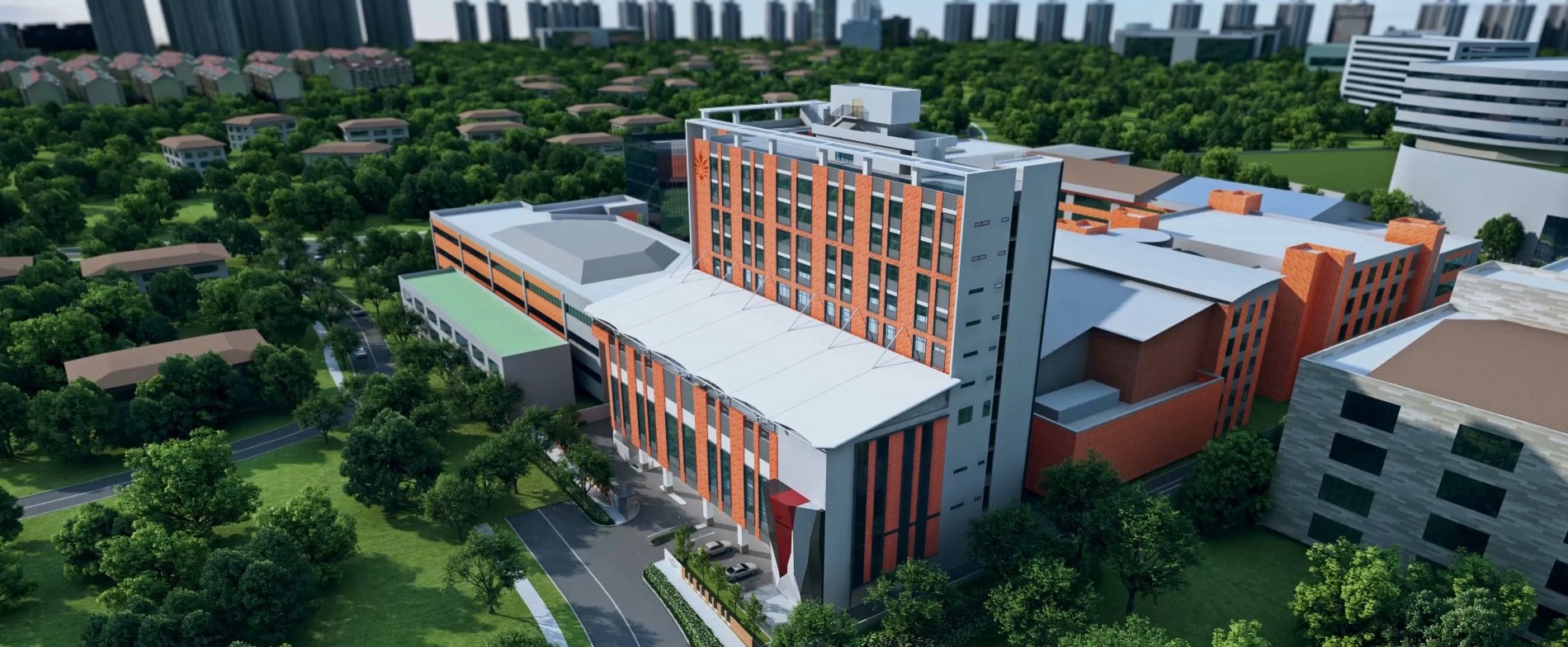
The school's lease on the Portsdown Road site was extended to 2038 in 2014. In January 2023, Tanglin unveiled the Centenary Building, an eleven-storey structure that accounts for nearly a quarter of the school's total floor space. The building houses a 50-metre competition-standard swimming pool, an Olympic-standard gymnastics centre, a multi-floor music department including a recording studio and rehearsal halls, and The Institute at Tanglin, a thought-leadership forum for students. A Junior Arts Centre, developed from the former Junior School tower block, opened in 2025 as the school marked its hundredth year. The same year, Tanglin launched a fifteen-acre campus in Gippsland, Australia, from which it runs the Highlands Programme, a five-week residential curriculum experience for Year 9 students.
Present Day
Tanglin Trust School, as WhichSchoolAdvisor reported on the school's centenary, has grown from five children in a club hut to a roll of around 2,800 pupils drawn from more than fifty nationalities, aged three to eighteen. It remains a registered charity; all fees are reinvested into the school. Craig Considine, an Australian educator who previously held headships at Geelong Grammar School and Wanganui Collegiate School in New Zealand, has led the school since 2018. In 2023 it was named International School of the Year by ISC Research, and the Spear's Schools Index placed it among the top 100 private schools in the world for the fifth consecutive year in 2026. Examination results in 2025 showed 63 per cent of A Level grades at A* or A, well above the England average of 28.2 per cent, and 79 per cent of IGCSE grades at A* or A against 49.2 per cent for independent schools in England.