Singapore · History
One hundred years on Portsdown Road: the making of Tanglin Trust School
Founded in a Tanglin Club supper shed in 1925 with five pupils, Tanglin Trust School is Southeast Asia's oldest British international school, now home to around 2,800 students from more than 50 nations.

In March 1925, Anne Griffith-Jones OBE opened a small school in a disused supper shed on the grounds of the Tanglin Club in Singapore. She had five pupils and a clear purpose: to give the children of British expatriate families a local alternative to being packed off to boarding school in Britain at a young age. The school took the name of its first address. That modest start is the origin of what is today Southeast Asia's oldest British international school.
Origins
Griffith-Jones, widely known to pupils as "Miss Griff," founded what she called the Tanglin Day School. It served children up to the age of eight and grew quickly. By 1934 demand had stretched far enough that the school opened a boarding section at Cameron Highlands in Malaya, offering families a cooler climate for younger children. The arrangement lasted until 1941, when a polio outbreak closed the Cameron Highlands school. The following year the Japanese occupation forced the Singapore school to close entirely, and in 1943 Griffith-Jones herself was interned in Changi Prison. Both schools reopened between 1946 and 1947, once Singapore was liberated.
Growth and consolidation
The postwar decade brought structural change. In 1954 a separate school, the Singapore Harbour Board School at Raeburn Park, opened to serve the children of the Board's own expatriate staff. In 1958 the British European Association (BEA) bought Tanglin School and formed Tanglin Trust Ltd. Management of Raeburn Park transferred to the BEA in 1960, bringing both institutions under the same board of governors.
Around 1960 and 1961 the original Tanglin school relocated to new premises at Matheran on Tanglin Road and was renamed Tanglin Preparatory School. Demand kept rising. In 1971 the waiting list was long enough to justify a third school: Weyhill Preparatory School, opened on Portsdown Road. In 1976 Raeburn Park moved to Portsdown Road as well, settling opposite Weyhill, and a nursery unit called Winchester School opened at Alexandra Park the same year.
The three Portsdown Road schools, Tanglin Preparatory, Raeburn Park, and Weyhill, were amalgamated in 1981 to form Tanglin Infant School and Tanglin Junior School on a single campus. Six years later, in 1987, administration was centralised under one headteacher, Mrs Veronica Goodban. Winchester Nursery at Alexandra Park closed in 1996, its nursery provision absorbed into a new purpose-built unit at Portsdown Road. That same year the institution adopted its current name: Tanglin Trust School, as reported on WhichSchoolAdvisor.
Curriculum and identity
Tanglin has operated throughout its history as a not-for-profit organisation, registered as a charity, with all tuition fees reinvested into the school. It delivers the English National Curriculum from Nursery through to Year 9, then IGCSE in Years 10 and 11. At Sixth Form it offers a dual pathway, unique in Singapore, of either A Levels or the IB Diploma Programme. The IB was introduced in 2009; the first cohort graduated in 2011. The 2026 IB results placed the school's provisional average diploma score at 39.1 points, well above the world average of 30.88, with a 100 percent pass rate.
Tanglin is the only international school in Singapore inspected under the British Schools Overseas (BSO) framework, which is recognised by Ofsted. It has been rated "Outstanding" in every category across every inspection, including the 2025 cycle, covering quality of education, personal development, welfare and safety, and leadership and management. The Infant School holds a further distinction: it is the first school in Asia to be awarded both the Early Years Quality Mark and the Primary (Infant) Quality Mark. Tanglin also holds accreditation from the Council of International Schools (CIS) and COBIS.
Campus and recent development
The school has occupied its current address at 95 Portsdown Road since the 1981 merger, situated within Singapore's "one-north" technology cluster near Rochester Park and the Wessex Estate. Its lease on that site runs to 2038. The campus houses four separate school buildings, one each for the Infant, Junior, Senior, and Sixth Form divisions, arranged around a shared central playing field.
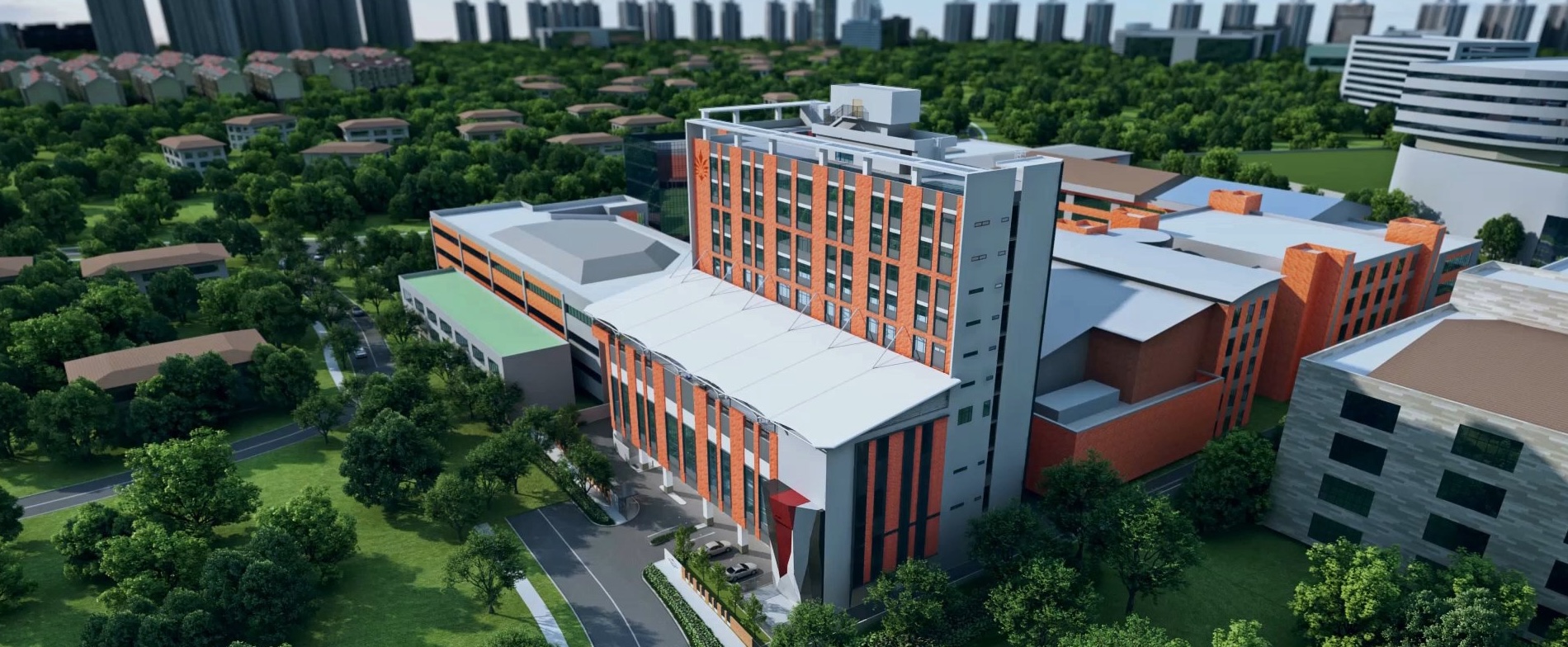
The largest single addition to the campus in recent decades was the Tanglin Centenary Building, which opened formally on 11 January 2023. The 11-storey structure added roughly 25 percent to the school's total floor space. Its facilities include a 50-metre Olympic-length swimming pool, an Olympic-standard gymnastics centre, a 15-metre climbing wall made by the makers of Climbing World Championship walls, a two-floor music department with a recording studio and 100-person rehearsal hall, and the Institute at Tanglin, a thought-leadership forum on the top floor. A Junior Arts Centre followed in 2025. The Centenary Building won the "Best New Campus" award at the Singapore Education Awards 2024.
The centenary year also brought the Highlands Programme, a five-week experiential learning course for Year 9 students at a new 15-acre Tanglin Gippsland campus in Australia. It is the school's first campus outside Singapore.
Present day
Craig Considine has served as CEO since 2018, succeeding Peter Derby-Crook, who led the school for more than eight years. Considine came from Millfield School in England, where he was headmaster for a decade, and earlier held headships in New Zealand and posts at Australian independent schools. Under his leadership the school introduced a unified house system in 2021, linking every student from Nursery to Year 13 under one of eight houses, each named for a location significant in the school's history: Alexandra, Cameron, Claymore, Portsdown, Raeburn, Wessex, Weyhill, and Winchester.
The school currently enrols approximately 2,800 students from more than 50 nationalities. Around 96 percent of graduates secure places at their first or second choice universities worldwide. Tanglin has been named International School of the Year by ISC Research (2023) and by HoneyKids Singapore Education Awards in consecutive years (2024 and 2025). It remains oversubscribed, operating a waitpool rather than a standard waiting list.