Shanghai · History
How 23 students in Pudong became China's first Dulwich College
Founded in 2003 by a British lawyer and his wife who couldn't find the right school for their children, Dulwich College Shanghai Pudong now educates more than 1,600 students and anchors a network that spans Asia.

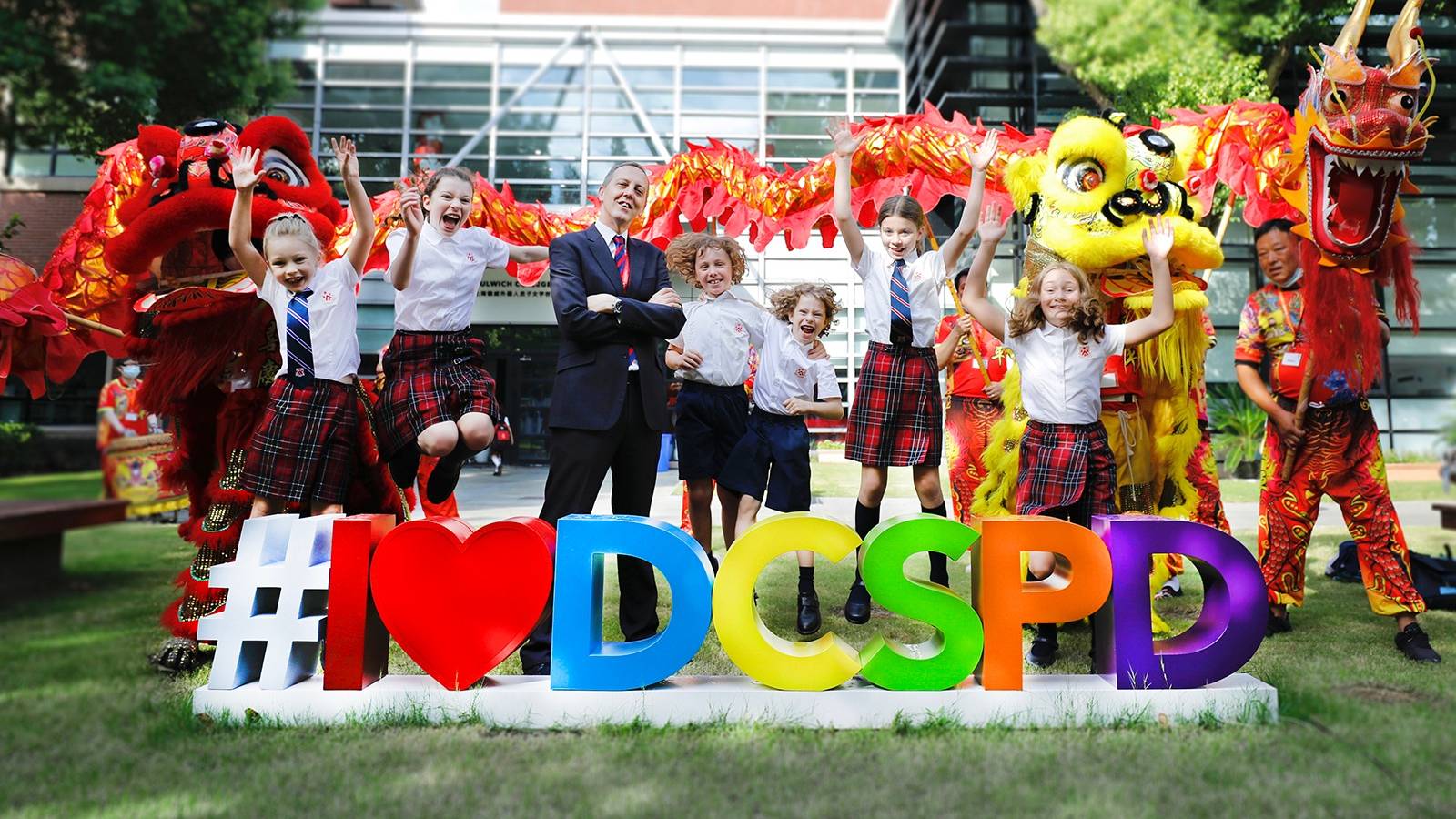
British lawyer Fraser White and his wife Karen Yung moved to Shanghai in the early 2000s with three young children and a problem: no school in the city offered the combination of academic rigour, strong co-curricular life, and genuine international community they were looking for. Their search, as the British Chamber of Shanghai has recorded, came up short.
A chance encounter with Graham Able, then Master of Dulwich College in London, changed that. White and Yung put the idea of an international Dulwich campus in Shanghai to the London governors. Under the chairmanship of Eddie George, then Governor of the Bank of England, the college agreed to a 100-year global partnership. The result was Dulwich College Shanghai Pudong, inaugurated on 22 July 2003 by former British Prime Minister Tony Blair and Vice Mayor of the Shanghai Pudong New District, Dr. Zhang En Di.
The school opened with 23 students. Colin Niven was its first Head of College. It was, according to the British Chamber of Shanghai, the first independent British school to open in China.
Growth
Growth was steady. In 2007, a watershed year by the school's own account, the first cohort of Dulwich Pudong students received IGCSE results, and a new Junior School building was formally opened by HM Consul-General Shanghai, Carma Elliott OBE, and Vice Mayor Zhang En Di. The Science Block, the most recent major facility addition, opened in 2018.
By 2016, demand was strong enough to justify a second Shanghai campus. Dulwich College Shanghai Puxi opened that year in the Minhang district on the other side of the city, on a purpose-built site of 40,000 square metres.
The Pudong campus sits in the leafy Jinqiao area at 266 Lan'An Road, with a separate DUCKS early years building nearby at 425 Lan'An Road. Facilities include a fully refurbished theatre, two drama black boxes, a recording studio, two gymnasiums, a dance studio, a 25-metre FINA swimming pool, and a 14,000-square-metre grass lawn.
The school is operated by Education in Motion (EiM), the group that White and Yung's original venture seeded. By 2023, EiM had grown to 13 schools across five countries. In August 2024, Reuters reported that Hillhouse Investment struck a deal to acquire Dulwich College International's schools in China, South Korea, and Singapore from EiM for approximately $600 million, with the Straits Times confirming the transaction later that year.
Curriculum and Accreditation
The school takes students from age two to 18. The youngest, in DUCKS (Toddler to Year 2), follow a dual-language programme rooted in the UK Early Years Foundation Stage, with English and Mandarin taught together. From Year 1, students follow the English National Curriculum; in Year 10 they move to IGCSE; and senior students take the IB Diploma. Mandarin is taught throughout, via native, second-language, and foreign-language pathways, all the way to IGCSE and IB.
Accreditation is extensive. The school holds full accreditation from the Council of International Schools (CIS), most recently re-accredited in June 2025, and from the Western Association of Schools and Colleges (WASC). It is an IB World School. In February 2025, it was admitted to the Heads' Conference (HMC), placing it alongside Eton, Charterhouse, Westminster, and its founding school, Dulwich College London. The Deputy Master (External) from Dulwich College London inspects the campus annually. The school is also a certified test centre for ABRSM music and LAMDA drama examinations, and an audition centre for Berklee College of Music.
Present Day
Garry Russell has been Head of College since August 2022. The school carries more than 40 nationalities across a roll of over 1,600 students. The Class of 2025 averaged 38 IB points out of 45. The 2024 cohort averaged 37.5, which was, according to published reports, the highest IB average in China that year and well above the global average of 30.3. That marked the third consecutive year the school led China in IB performance. In recent leavers' cycles, 91 percent of graduates received offers from universities ranked within the QS World Top 100, with destinations including Imperial College London, Cambridge, NYU, Brown, Columbia, and Stanford.
The school's motto, Detur Pons Mundo, translates as Building Bridges to the World. It is a phrase the founders could reasonably claim they took literally: a school started to solve one family's problem in Pudong became the seed of an education group that, two decades on, is valued at around $600 million.