Singapore · History
From five pupils in a club hut to a century of British education
Tanglin Trust School opened in 1925 with five pupils and no qualified teacher. A hundred years on, it is the oldest British international school in Southeast Asia and the only one in Singapore rated Outstanding by BSO across every category.

Origins
Anne Griffith-Jones arrived in Singapore in 1923 intending to stay three months. She stayed for life. In March 1925, with no formal teaching qualifications, she opened Tanglin School in a disused supper shed on the grounds of the Tanglin Club, with five pupils. The school outgrew those huts quickly. Assembly moved to the club ballroom; the Men's Bar was pressed into use as a classroom. She became known to generations of children simply as "Miss Griff."
In 1934, Griffith-Jones extended the school's reach northward, opening a boarding section in Cameron Highlands, Malaya, where the cooler climate was thought healthier for young children. It ran until 1941, when a polio outbreak forced closure. The following year the Singapore school itself closed, as Japanese forces occupied the island. In 1943, Griffith-Jones was interned in Changi Prison. Both schools reopened in 1946 and 1947 as the occupation ended.
The Trust Takes Over
By the mid-1950s, with Singapore moving toward self-rule, Griffith-Jones was in her mid-sixties and thinking about retirement. She approached the British European Association in 1957 with concerns about the school's future. The BEA took over in May 1958, establishing Tanglin Trust Ltd to preserve British educational provision in Singapore. The Tanglin Club roots were left behind; the school moved to a black-and-white colonial building called Matheran on the corner of Tanglin and Jervois Roads.
Two other schools were part of the same orbit. Raeburn Park School, opened in 1954 by the Singapore Harbour Board for children of its expatriate staff, came under Tanglin Trust management in 1974, sharing a board of governors with Tanglin Preparatory and the newer Weyhill Preparatory School. In 1976, with the final withdrawal of British troops from Singapore, Raeburn Park moved to Portsdown Road, where it sat opposite Weyhill, both schools sharing a playing field but running separately.
The 1981 Merger and Portsdown Road
In 1981, Tanglin Preparatory, Raeburn Park, and Weyhill Preparatory amalgamated at the Portsdown Road site, forming Tanglin Infant School and Tanglin Junior School. It was, as the school's own records describe it, the start of the vision to create one school. The two divisions initially ran largely independently. In 1987 they were brought under a single headteacher, Mrs Veronica Goodban, as Tanglin Infant and Junior School.
In 1996 the Winchester Nursery School, which had operated at Alexandra Park since 1976, closed and a new nursery unit opened on the Portsdown Road site. That same year the institution adopted the name it carries today: Tanglin Trust School. None of the original buildings on that campus survive, but the school's house names, including Cameron, Raeburn, Alexandra, Weyhill, and Portsdown, still map the geography of its history.
Senior School and Sixth Form
The school added a senior school to the Portsdown Road campus and opened its first Sixth Form in 2001. In 2009 it introduced the International Baccalaureate Diploma alongside A Levels, making it the only school in Singapore to offer both post-16 pathways. The first cohort of IB students graduated in 2011. The school's lease on Portsdown Road was extended in 2014 to run to 2038.
Curriculum and Accreditation
Tanglin follows the English National Curriculum from Nursery through to Year 9, with IGCSE qualifications in Years 10 and 11, and the choice of A Levels or the IB Diploma in Sixth Form. It is accredited by BSO, COBIS, and CIS, and is an IB World School. The Infant, Junior, and Senior Schools have each been rated Outstanding, the highest possible grade, in BSO inspections. The 2025 inspection confirmed Outstanding across every category, making Tanglin the only school in Singapore to hold that distinction consecutively. The Infant School was the first in Asia to receive both the Early Years Quality Mark and the Primary Quality Mark, and the Nursery was the first in Asia to achieve Curiosity Approach Accreditation. In 2023, Tanglin was reaccredited Gold under the UNICEF Rights Respecting School Award, the first school outside the United Kingdom to reach that level.
Campus and Recent Development
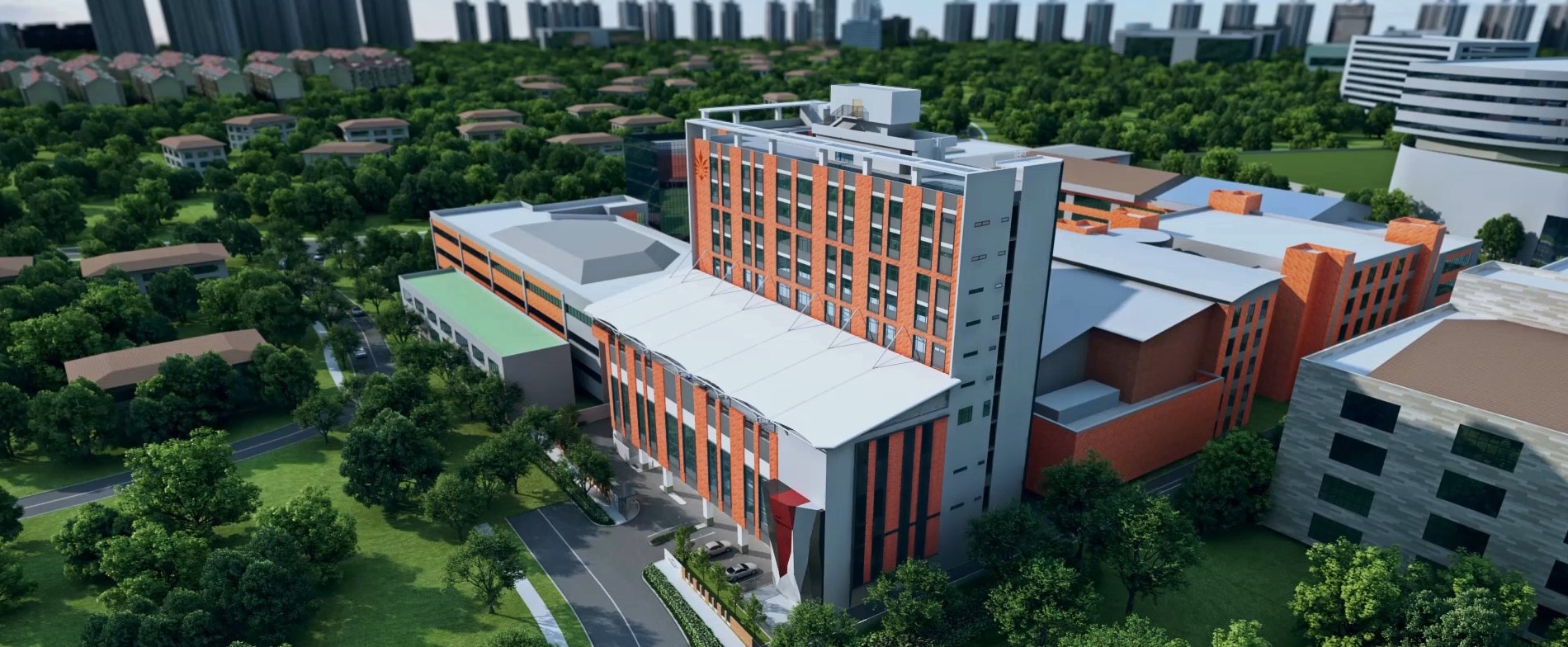
The school's centenary in 2025 was preceded by a major capital investment. The Tanglin Centenary Building, an 11-storey structure unveiled in January 2023, added a 50-metre competition-standard swimming pool, an Olympic-standard gymnastics centre, a 15-metre climbing wall, an athletic development gym, and a two-floor music department with a recording studio and rehearsal halls. In 2025, the Junior Arts Centre, a redeveloped five-storey facility formerly known as the Junior School Tower Block, opened as a dedicated arts hub. That same year the school launched the Tanglin Highlands Programme, a four-week immersive outdoor learning experience for Year 9 students at a new 15-acre campus in Gippsland, Australia, drawing a conscious line back to the Cameron Highlands boarding school of 1934.
Present Day
Tanglin Trust School sits on Portsdown Road in Singapore's one-north district, adjacent to the Wessex Estate conservation area. It is a non-profit institution; all tuition fees are directed back into the school. The roll stands at approximately 2,800 students from more than 50 nationalities, aged 3 to 18, divided across Infant, Junior, Senior, and Sixth Form schools on a single campus. The CEO is Craig Considine. Spears named Tanglin among the top 100 private schools in the world and among the top 15 in Asia Pacific for the fifth consecutive year in 2026. It remains oversubscribed, operating a waitpool rather than a chronological waitlist.