Vietnam Calls on UK Partners to Help Embed English in Every State School
A delegation in London this week advanced a bilateral MoU and explicitly invited British education groups to support Vietnam's national policy of making English a second language across all schools by 2035.

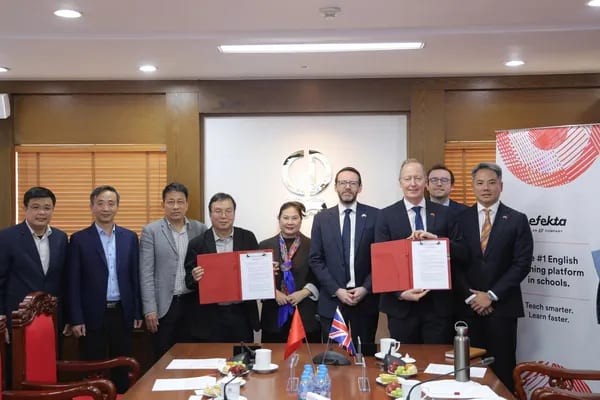
Vietnam is actively inviting British education operators to support its national programme of making English a second language in every school, after a delegation led by Standing Deputy Minister of Education Pham Ngoc Thuong held two days of talks in London on 23 and 24 November. According to Vietnam Plus, the visit was designed to convert an October 2026 memorandum of understanding into concrete cooperation, with the government targeting full English as a second language status by 2035.
The delegation met UK Minister of State Baroness Smith and officials from the Department for Business, Innovation and Science, as well as the British Council and commercial providers including Pearson, Efekta Education and uTalk. Teacher development and EdTech and AI platforms were confirmed as the two priority cooperation tracks.
What the invitation means for operators
The official framing is policy-led, but the commercial signal is clear. Vietnam is explicitly naming UK education groups as delivery partners, and the London meetings included both government agencies and private providers. For British-curriculum schools already operating in the country, the signal from Hanoi is that official attitudes toward UK-model schools remain supportive and that the market infrastructure, including teacher permit reforms enacted earlier this year, is being built out deliberately.
For operators still weighing entry, the visit suggests the government's English-language ambitions create a structural tailwind. As English-medium education gains official priority, demand from Vietnamese families for UK-branded schooling is likely to remain durable. The state drive is focused on the government school sector; premium private operators are positioned well above that level and are not competing for the same families.
A crowded but expanding market
Vietnam has seen a surge of British school openings in 2026. Rugby School, Uppingham and King's College Wimbledon have all moved from planning to operation this year, and Ardingly College opened admissions offices in Hanoi and Ho Chi Minh City in October. The London talks confirm that the Vietnamese government is treating this wave of UK operators as a resource in its own policy programme, not merely as a commercial side-effect of rising affluence.
For local families, the direction of travel reinforces what already shows up in the fee data: top-tier international school places in Ho Chi Minh City are approaching USD 38,000 a year, and demand has held up. The parents paying those fees are unlikely to be replaced by state-school English teaching. The two segments are not in competition; they are growing in parallel.